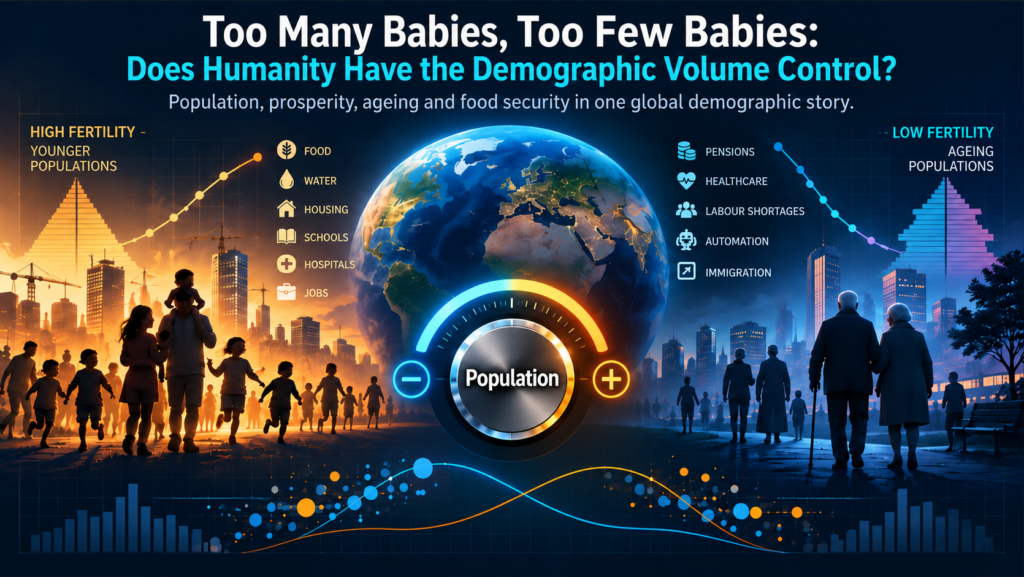
Population is one of those subjects where almost every direction seems capable of making economists nervous.
Understanding population growth and ageing is essential to assessing their effects on economic development, workforce availability, food security and the long-term sustainability of societies.
When population grows rapidly, the questions arise immediately: Where will the jobs come from? Can agriculture keep up? What happens to water demand? How many schools, houses, hospitals and roads will be needed?
Slowing population growth may seem like the obvious response, but demographic change has a habit of creating a new set of questions: If fertility stays very low, where will the workers come from? Who will support an ageing population? What happens to pensions, healthcare systems and economic growth?
There is no single demographic setting that works everywhere. Humanity has somehow managed to worry about too many people and too few people at the same time.
That sounds contradictory, but it is not.
One Planet, Very Different Demographic Stories
The challenge is one of balance, and the global demographic picture is extraordinarily uneven. Some countries have fertility rates of five or more children per woman. Their populations are exceptionally young, and millions of children will enter schools, labour markets and food systems over the coming decades.
At the other end of the spectrum are countries where fertility has fallen close to one child per woman. Their concern is not primarily accommodating rapid growth, but sustaining a sufficiently large workforce as the share of older citizens rises.
Neither condition automatically guarantees success or failure; they represent very different demographic starting points.
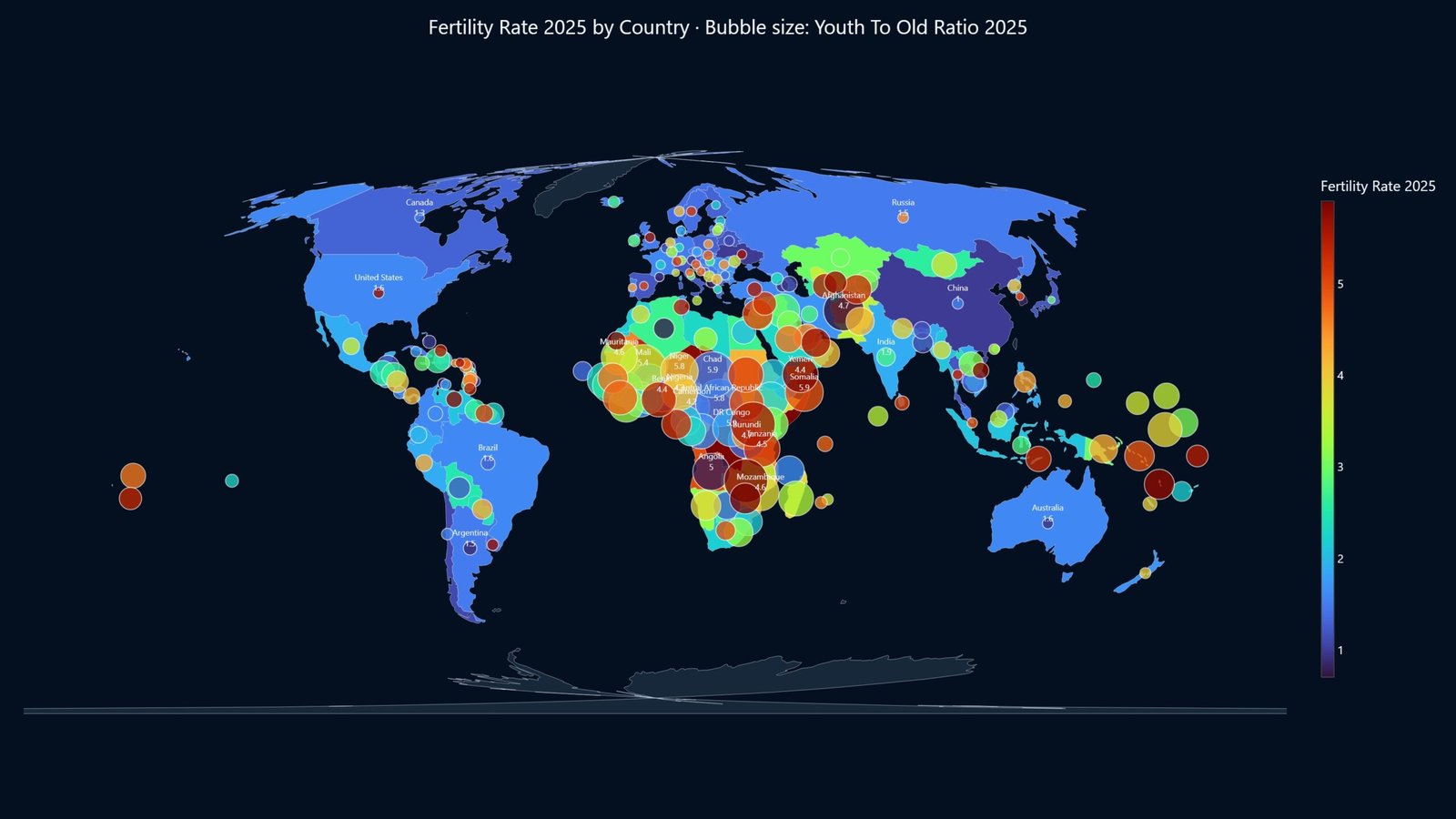
Figure 1 shows that the world is not moving through the demographic transition at the same speed. Some societies are still expanding rapidly; others are already asking where the next generation went.
A Baby Today Is an Economic Variable Twenty Years from Now
That sounds terribly unromantic, so perhaps it should not appear on a greeting card. Economically, however, it is true.
A child born today initially requires food, healthcare, housing and education. With sufficient investment, that same child eventually becomes a worker, entrepreneur, researcher, farmer, engineer, taxpayer or business owner.
This is why a young population can be an enormous economic advantage. But the demographic dividend is not automatic. Without adequate nutrition, education, health, skills and productive employment, a growing labour force does not turn itself into prosperity simply because a spreadsheet says it should.
The word dividend matters. A dividend normally follows an investment, and the demographic version has no exception.
When the Population Pyramid Looks More Like a Christmas Tree
Young countries generally have broad-based population pyramids, with many children and relatively few older people. As fertility declines and life expectancy rises, the shape gradually changes. Countries such as India and China illustrate how differently age structures can evolve.
The youth-to-old ratio offers a useful summary, particularly when viewed alongside fertility and total population rather than on its own.
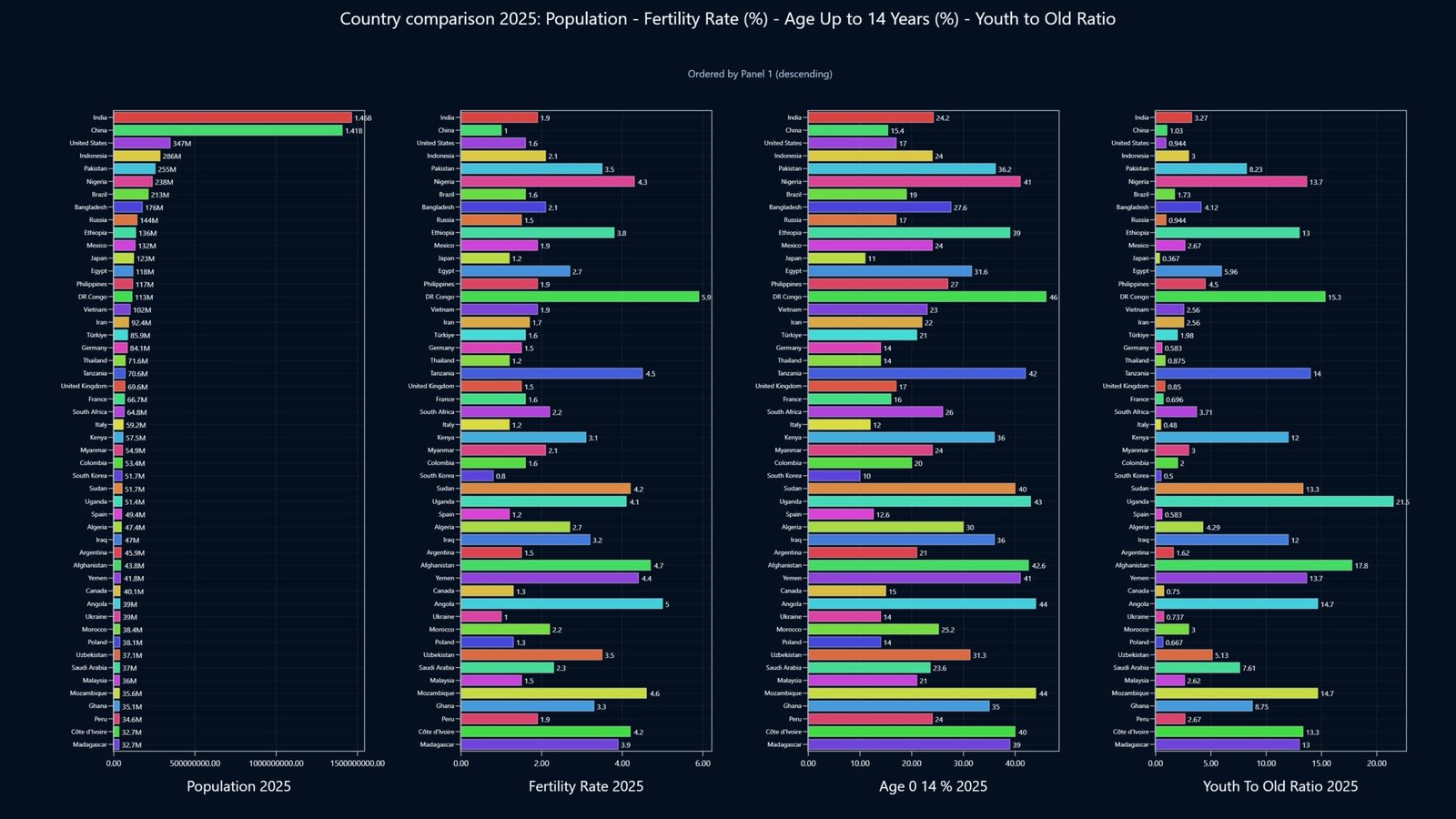
Pakistan, for example, remains a young country, with roughly a third of its population under 15 and a comparatively small share aged 65 or over. That creates considerable potential, but also considerable responsibility: millions of young people will need education now, skills next and productive employment soon afterward.
Japan and, increasingly, China face a different challenge. Rather than accommodating another enormous generation of children, they must sustain economic activity as older citizens account for a larger share of the population.
Therefore, one side may ask: How do we create enough jobs for everyone?The other: Where did everyone who was supposed to take these jobs go?
Demography has its own sense of humour!
More People Can Mean a Bigger Economy, but Not Necessarily a Richer One
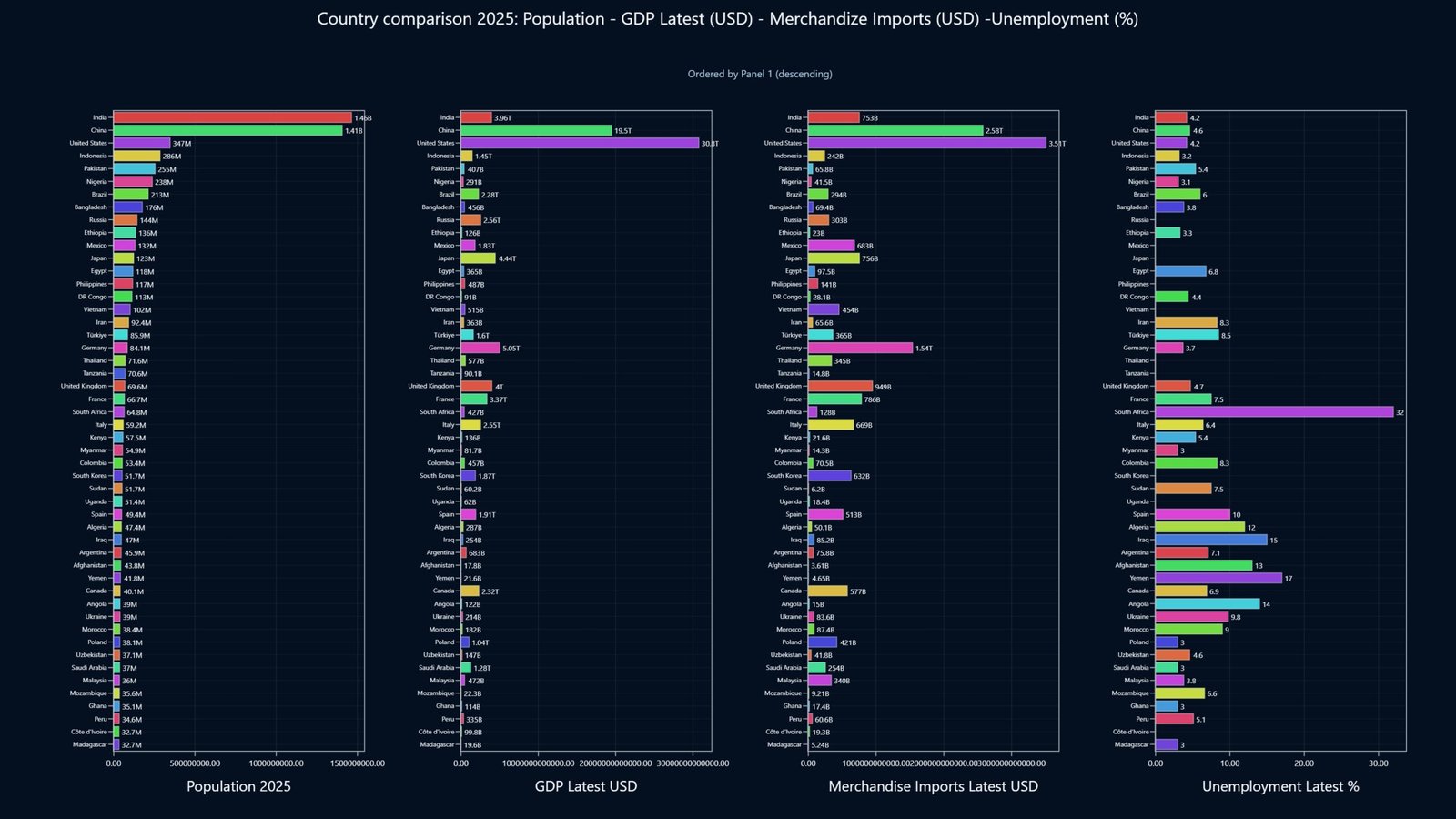
Population growth can enlarge an economy simply because there are more workers and consumers. But total GDP and individual prosperity are not the same thing.
If an economy grows by 3% while its population also grows by 3%, output per person may barely improve. This is why population growth should be examined alongside real economic growth and, ultimately, productivity and income per person.
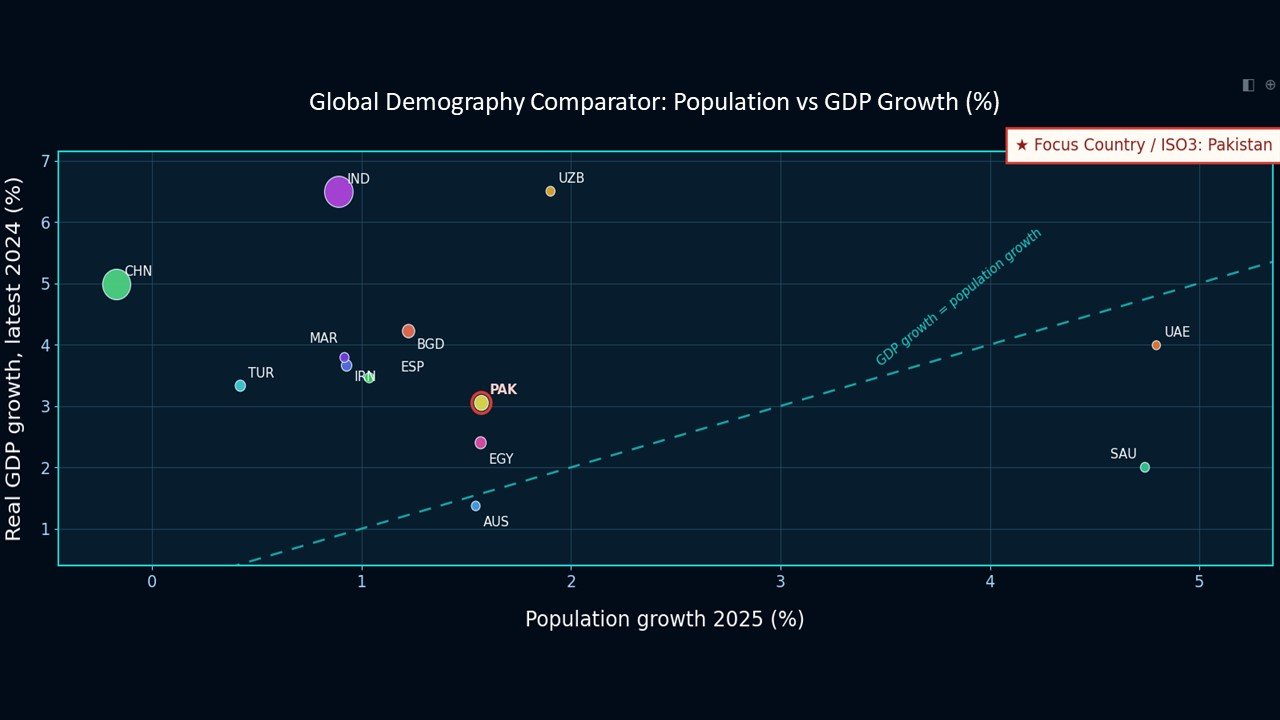
The important distinction is not simply which country has the fastest-growing population or economy. It is whether improvements in output, productivity and employment are sufficient to raise living standards over time.
Figure 3 is a useful starting point, although a full assessment would also require comparable-year GDP-per-capita and labor-market data.
When population growth is matched by investment, productivity and job creation, it can expand both the workforce and domestic markets. When the capacity to provide services lags behind, governments face an increasingly familiar shopping list: More schools, more hospitals, more electricity, more housing, more food, more water and more roads, i.e. more everything.
A fast-growing population can be a powerful economic engine. It also needs a substantial supporting vehicle.
The Curious Relationship Between Prosperity and Fertility
One of the most interesting global relationships is between fertility and GDP per capita. Wealthier economies generally tend to have lower fertility, but this does not mean that having fewer children automatically creates prosperity.
Development changes family decisions in several ways: education expands, child mortality declines, women gain more opportunities, urbanization rises and the financial cost of housing and raising children becomes more visible. People may also marry or have children later. Income is only one part of this story.
In many prosperous cities, having a child can feel suspiciously similar to launching a small infrastructure project.
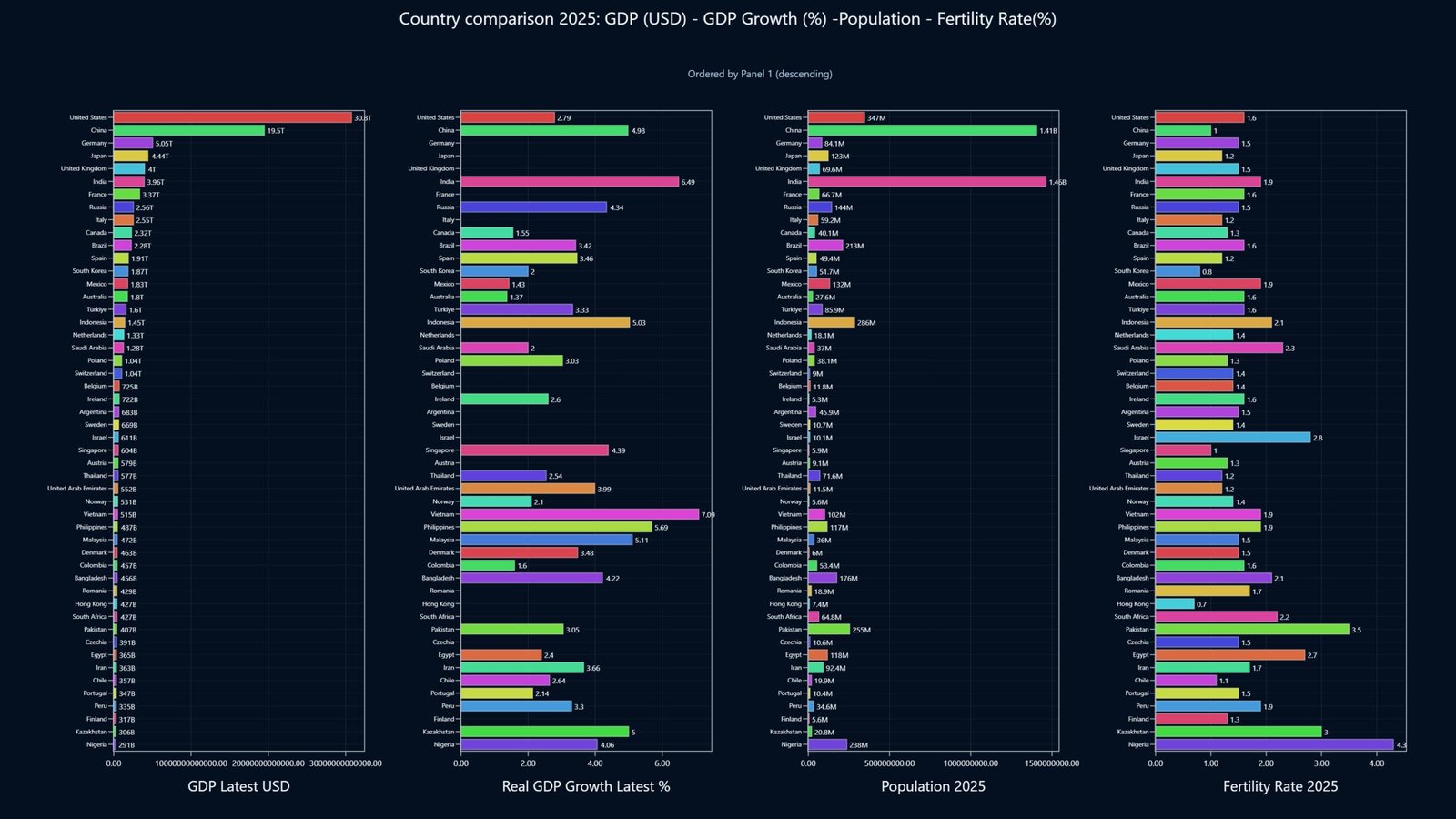
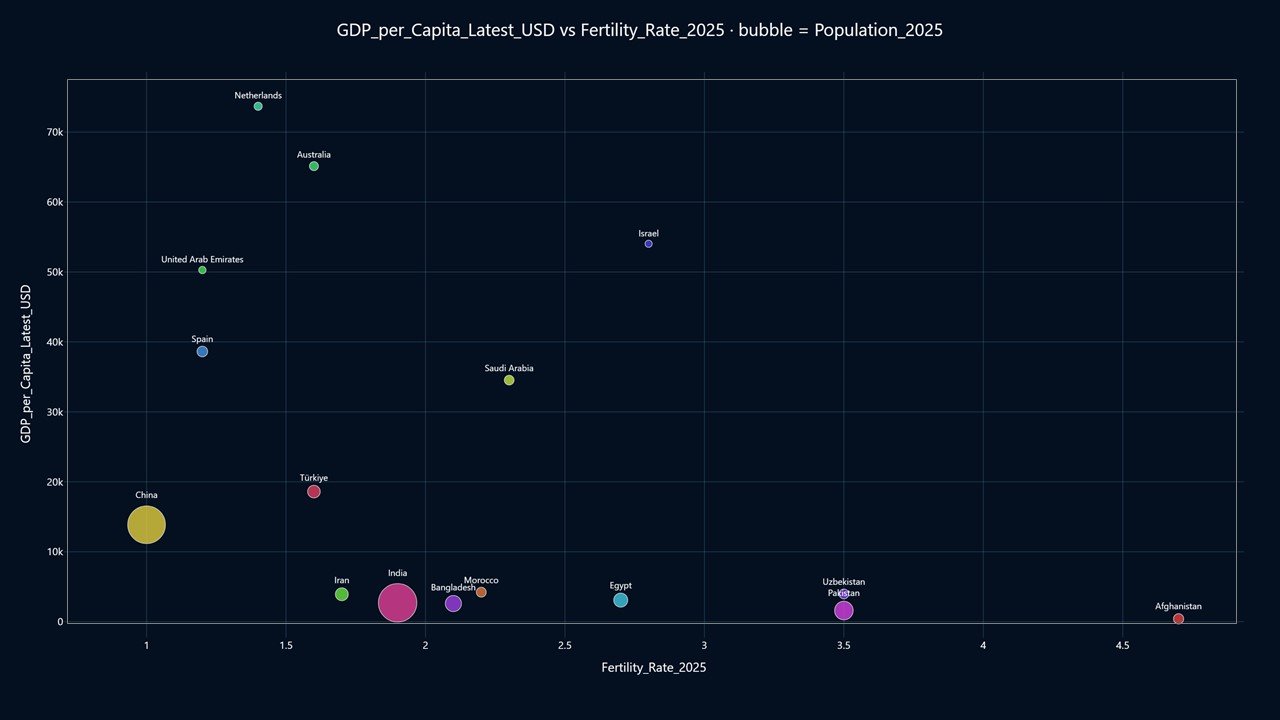
Very low fertility brings its own economic questions. When successive generations are smaller, the pool of new workers may eventually contract even as the retired population grows.
Governments and employers may respond through higher workforce participation, later retirement, productivity gains, automation or immigration. Some governments also try to make family formation more affordable through childcare, housing or parental-support policies.
Demographic policy can sometimes resemble someone adjusting a shower: too hot, too cold, then too hot again.
And Then Everyone Has to Eat
This is where population stops being an abstract demographic number and walks directly into the supermarket. More people require more food.
That sounds obvious, but the consequences extend far beyond producing more wheat or rice. Growing populations need vegetables, fruit, dairy, edible oils, animal protein and processed foods, together with storage, transportation, refrigeration and retail capacity.
As incomes rise, diets can change as well. People do not necessarily eat larger quantities of exactly the same foods; they often demand a more varied mix, sometimes with higher resource requirements.
Food demand can therefore rise because of population growth and changing consumption patterns at the same time. The pressure is especially acute where production and supply chains struggle to adjust.
(FAO: The State of Food Security and Nutrition in the World)
A rapidly growing country does not necessarily become food-insecure. Better agricultural productivity, improved irrigation, reduced post-harvest losses, better storage and well-functioning trade can help food systems adapt.
Nevertheless, demographic pressure makes those improvements more urgent. Where population and dietary demand outpace domestic supply for long periods, the effects may appear in prices, trade requirements, nutrition or some combination of the three.
Mathematics is very patient; eventually it sends the bill.
Food Security Is Not Just About Producing More
It is tempting to reduce food security to one instruction: grow more food. But food systems are considerably more complicated.
Producing a tomato is useful, but allowing it to rot between the farm and the consumer is less useful.
Producing wheat is useful, but losing significant quantities because of poor storage is less useful.
Growing fruit is useful, but having inadequate refrigerated transportation during a heat wave is distinctly inconvenient.
Countries facing rising food demand need not only agricultural output, but also preservation, storage, efficient logistics, processing, water efficiency, market access and sensible trade arrangements.
The demographic challenge spreads through the entire food chain.
What Happens When Population Growth Becomes Very Low?
A shrinking or ageing population does not eliminate food-system challenges; it changes their shape.Consumption patterns evolve, and rural communities may age even faster than urban ones.
Agriculture may face labor shortages and turn to mechanization or automation, while food industries adapt to new dietary and healthcare needs.
The question can shift from: Can we produce enough food for everyone? to: Can we maintain an efficient food system with fewer workers and an older population?
Different problem, same refrigerator.
So What Is the Perfect Fertility Rate?
This would be a convenient point to reveal the magical number. Unfortunately, there isn't one.
A sustainable fertility rate depends partly on mortality, migration, age structure, economic productivity and the country's existing demographic profile. Replacement-level fertility is often discussed as being around 2.1 births per woman in low-mortality populations, but even that is not a universal policy target.
The more useful goal is demographic stability and adaptability. Rapid-growth countries benefit when families have good access to education, healthcare, maternal care and voluntary family-planning information.
Low-fertility societies benefit when people who want children do not find that housing costs, childcare expenses or work conditions make family formation almost impossible.
The objective should not be to tell people how many children they ought to have. The objective should be to create conditions in which individuals can make informed choices while society remains capable of supporting the demographic outcome.
Perhaps What We Need is a Demographic Thermostat
Population debates are often presented as alarms: “Population explosion”
Then, a few decades later: “Population collapse”
Perhaps a thermostat is a better metaphor. If demographic growth becomes too rapid relative to resources and economic capacity, pressure rises. If fertility remains extremely low for long periods, workforce and ageing pressures can increase.
The ideal setting will not be identical everywhere; it will also change over time.
That is why population policy should focus on adaptability rather than fear.
Population Is More Than a Headcount
Countries can count people with remarkable precision. But knowing how many people live within a country's borders tells us surprisingly little about whether that population will become an economic strength or a social burden.
The more important questions concern what happens to people throughout their lives. Are children nourished and educated? Do young adults have opportunities? Can women participate fully in economic life? Can workers support their families? Can agriculture feed society efficiently? And can older people live with dignity and security?
These outcomes matter because population size alone creates neither prosperity nor crisis. A large young population can become a powerful demographic dividend if people are healthy, skilled and productively employed.
The same population can become a serious economic and social pressure if education, jobs, infrastructure and food systems fail to keep pace. Likewise, an ageing population is not automatically a problem if productivity, healthcare, pensions and labour-market adaptation are strong enough to support it.
So, the most important demographic question is not: Do we have too many people or too few?
It is: Are we investing well enough in the people we already have?
That question applies just as strongly to a country experiencing rapid population growth as it does to one facing declining fertility and ageing; and it may be the one demographic question that almost every society, regardless of where it stands in the population transition, eventually has to answer.
One Final Thought
We, being humans, invest considerable effort in forecasting populations to 2050, 2075 and 2100. We construct increasingly sophisticated models of fertility, mortality, migration and ageing.
Governments publish forecasts, economists publish projections and researchers develop scenarios.
Yet the choices shaping our demographic future remain clearly decentralized: millions of families make personal decisions, generally without first consulting the national statistical office.
Perhaps that is how it should remain. Good policy should not dictate those decisions; it should help ensure that people can be healthy, educated, productive, economically secure and well fed, whatever demographic future emerges.
And if we achieve that, perhaps the population debate can stop shouting about whether there are too many people or too few.
At least until the economists discover something else to worry about.